If you’re considering investing in a marketing strategy but you have questions, you’re not alone. Ultimately what you’re getting is a blueprint for growth, or whatever your goals are, but you are still making an investment in something that doesn’t have an immediate correlation to ROI.
If you are considering investing in strategy it’s important that you know what it will and won’t do for you and what your involvement will need to be.
1. Will this actually help or just give me more homework?
A strategy tells you what to do and how to do it, so in that sense yes, you still have the work to do. But it takes the guesswork out of it so you can be confident that all of the resource you put into your marketing activities are moving you toward the goals you identified as part of the strategy. This means the work you do is more focused and you don’t waste time on things that are unnecessary.
Even without a strategy, most businesses are already doing plenty of work. They’re trying different tactics, researching what competitors are doing, wondering if they should be on the latest platform. It’s all work, it’s just without a strategy it’s unfocused work.
That said, if you genuinely don’t have the capacity to implement anything right now, a strategy won’t help. If you’re already stretched thin with no time, no team, and no budget for implementation, adding a strategy document on top just creates pressure and guilt. In that case, you’re better off waiting until you have capacity to actually execute, or looking at done-for-you services where someone else handles the implementation.
2. Can I afford both strategy and implementation?
This is the elephant in the room for many businesses. Strategy costs between £3,500 and £10,000+. Implementation costs more, whether that’s your time, your team’s time, or agency fees.
If you genuinely can’t afford both, you need to make a choice. One of the things we find helps businesses with this dilemma is swapping implementation for consultancy. That way you have an experienced professional on hand to advise on implementation, keep things moving forward, help track results and tweak accordingly.
3. What if budget is going to be an issue?
If neither full implementation nor ongoing consultancy are within your reach but you know you need to do something, you have a couple of options.
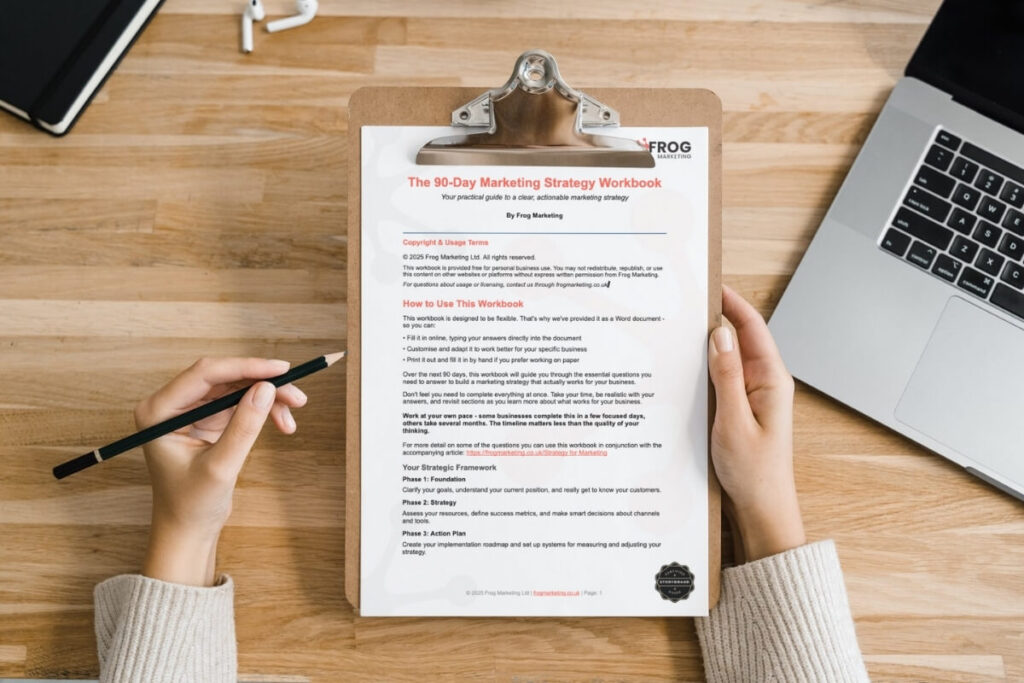
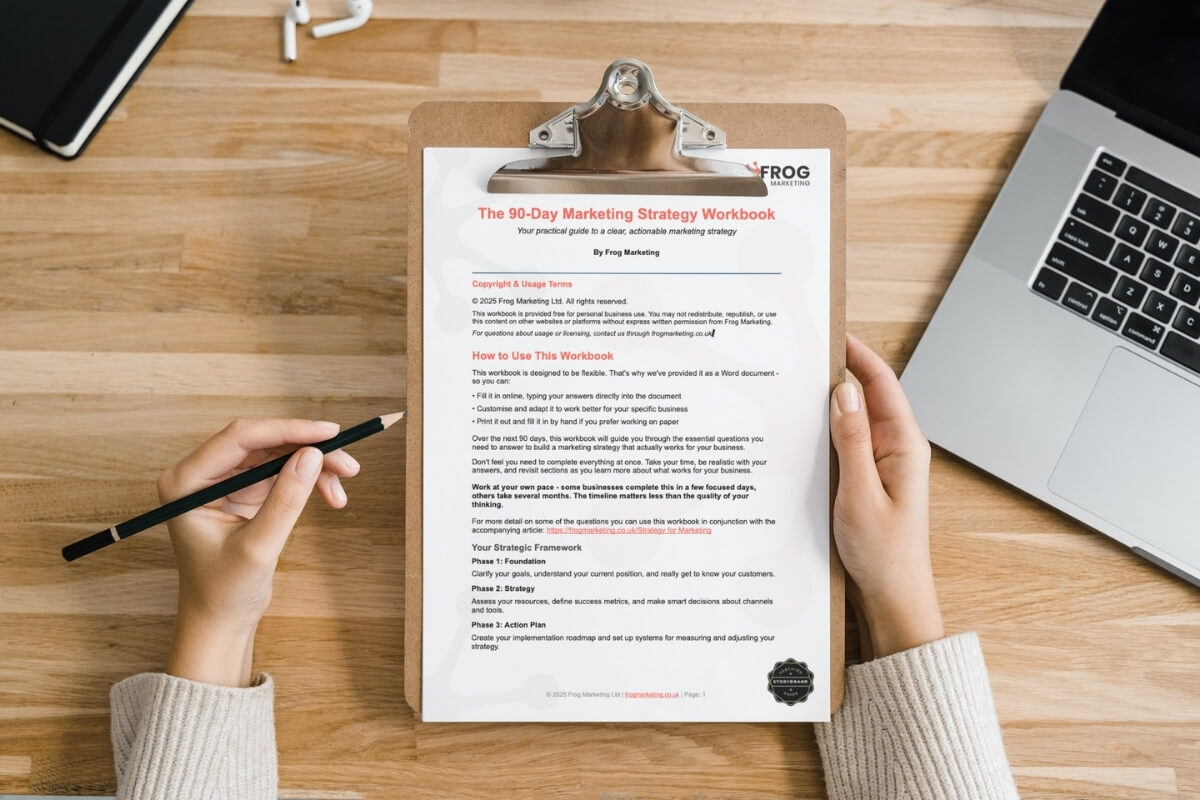
Option 1: Do the work yourself. We have a really comprehensive guide to creating a strategy with an accompanying workbook. You can work through this yourself, or book consultancy time to work through it together if you need some guidance.
Option 2: Start with focused consultancy. If you have a small budget but not enough time for the DIY approach, a few hours of consultancy can be more affordable than full strategy work. It may not have all of the data and research behind it, but talking things through with an experienced revenue-generating marketer is a solid starting point. A couple of hours can often be enough to give you an idea of how and where to focus your efforts initially. Once this is working, you can look at building on it with the next stage.
We offer this sort of consultancy, as do many others. Just ensure you’re talking to someone who values genuine ROI over aesthetics.
4. Is the strategy guaranteed to work?
This really depends on how you intend to measure success and what your parameters are for judging whether it has worked. This is also one of the reasons some people struggle with the concept of investing resources into creating a strategy.
A strategy can’t necessarily guarantee X leads or Y revenue. What it can do is map out what you need to do, what results you can reasonably expect from each activity, and how you can measure whether it has been successful.
The success of those measures depends on execution, market conditions, your specific context, and dozens of factors we can’t control. But what we can guarantee when we create a strategy is that it will be based on real data about your business, an honest assessment of your market, and our experience and knowledge of what’s most likely to work for you specifically.
5. Do I really need this or should I just start doing something?
This really depends on your situation. If there’s a channel you’re using that’s proving really successful and you just want to scale it, or there’s compelling evidence for a specific activity being the thing that will move the needle for you, you could just start.
Equally, if you’re happy to experiment and learn from trial and error, you could just start. Just bear in mind you may invest resources into things that don’t actually move you forward. And it may take a while to find the thing that works for you.
If you are going to just make a start, pick a channel, commit to it for six months, and see what happens. But make sure you have some way to track its effectiveness.
Strategy on the other hand is a roadmap. It makes sense when you’ve got budget to invest but you want to maximise your results in a shorter timeframe and have a really clear direction of where you want to go.
6. How do I know you understand my specific industry?
It’s very unlikely we’ll understand all the nuances of your industry from the start. However, this is quite often an advantage. We’re not bringing any preconceived ideas to the table. We’re not overlooking anything because we think we already understand.
We’re also hearing the answers to the questions we ask for the first time. This allows us the freedom to challenge traditional conventions in your industry and quite often leads to some really out-of-the-box thinking. “But why is it done like that?” and “does it need to be done like that?” are just two of the questions that sometimes affords unexpected answers. There’s also nothing like clarifying your thoughts on something when explaining it to someone who doesn’t know the intricacies of your industry.
Having worked with businesses across professional services, education, health, technology, and home services, we’ve learned that while industries differ, the process of strategic thinking is transferable. Good strategy is about asking the right questions and interpreting the answers in context, not about having pre-packaged solutions.
That said, if your industry is highly specialised or regulated in ways that require deep technical knowledge, you might be better served by a specialist consultant who lives and breathes your sector.

7. What if I can't implement it
This is a legitimate concern. A strategy you don’t implement is not going to help you move forward.
Before you invest in strategy, you need to be reasonably certain about your capacity to execute it. Do you have time to dedicate to it? Do you have someone who can own this or has the ability to implement it? If not, do you have the budget to pay someone else to do this?
If the answer to all of those is no, it’s probably not the right time for you to invest in a strategy. Wait until you have at least one of those things in place.
That said, a good strategy is built in phases for exactly this reason, so you don’t have to implement everything at once. Start with quick wins and high-impact priorities, then build from there as you have capacity. It really depends on what level of capacity you have. If the answer is none, even phased work will be too much.
If you’re worried about implementation, it’s good to have this conversation upfront. Many agencies can be fairly flexible. We offer done-for-you, done-with-you, or we can deliver the strategy for you and your team to implement yourselves.
8. Can't I just use AI to create a strategy these days?
Yes, you can. ChatGPT will happily generate a marketing strategy for you in minutes. And for some businesses, that’s enough.
AI is excellent at giving you a generic framework and standard tactics. What it can’t do is ask you the sort of questions that reveal what’s actually holding you back and then delve into your answers with the same human insight a person can. It can’t look at your data and tell you your conversion problem is more urgent than your traffic problem. It can’t challenge the assumptions you may not realise you’re making.
AI gives you information but a person gives you insight.
If you’re comfortable with the strategic thinking part and you just need a framework to organise your thoughts, AI tools are genuinely useful. If you need someone to challenge your thinking and spot what you’re missing, that’s where the human element matters.
We use AI in our work. It’s a helpful tool for speeding things up. It can get through data much quicker than a human for a start. But it’s very definitely an aid rather than a replacement, we have lots of experience using it and we know what it reliably makes a good job of and where it reliably fails!
A word of caution if you’re using AI for strategy: Check everything. Even with the right facts and figures, AI doesn’t always get things right.
It isn’t always good at context – it misses links and doesn’t always read very deeply or accurately into the data. It also quite often bases its output on businesses that are wildly different to you in size and shape.
Make your prompts as detailed as possible, but just understand that it can still be somewhat one-dimensional and generic.
9. What do you charge for a strategy?
Strategy projects typically range from £3,500 to £10,000+ depending on complexity. We provide a detailed quote after we’ve had a discovery call to assess things like the level of help you need, the amount of data to review, the number of different customer types you want to target, and the number of people or teams that might be involved in delivering the strategy.
Our strategies generally include:
- In-depth discovery meeting where we take a deep dive into your business
- Website and analytics review
- Detailed research and data analysis
- Positioning and brand messaging framework
- Customer journey mapping
- Channel recommendation
- Budget allocation
- Campaign-level strategy (types of campaigns, ad creative ideas)
- Inbound content strategy
- Conversion funnel strategy (landing pages, lead magnet, nurture flows)
- Tracking and measurement plan
- Timeline and roadmap plan with short, mid and long term priorities
- Expected ROI
- Risks (competition, ad costs, scaling risks) and how to mitigate
10. What's the difference between hiring you vs DIY options (templates, courses, free advice)?
Templates, courses, and free online content can all be excellent starting points. You can get marketing strategy templates for free, a strategy course for around £500, or find plenty of quality advice online. If you’re good at the DIY approach, enjoy learning, and have more time to invest than funds, these might be good routes. We provide a free strategy workbook you can download with an accompanying blog post that might be helpful.
The principles of good marketing strategy are well established and freely available. But fundamentally, the difference is application, accountability, and tailored guidance. Most businesses don’t struggle with lack of information, they struggle with what it means and what to do with it specifically for their situation.
DIY solutions and free advice are generic because they have to be – they’re designed for everyone. What’s harder is knowing which advice applies to your business, in your market, with your specific constraints. Equally, understanding how to find data, interpret it, and figure out how that relates to the other elements of your strategy is tricky to learn when you’re also trying to run your business and it’s not something you’re doing every day.
This is probably one of the major reasons so many business owners start courses they don’t finish or download templates they never use.
Paid strategy work gives you the opportunity to sit down and unpick things, have someone challenge you on assumptions, and delve deeper into the answers you give.
If however, you’re someone who finishes what you start and you’re comfortable making strategic decisions, give the DIY route a go. Doing something is always better than doing nothing.
So, is it right for you?
A marketing strategy makes sense if you’ve got marketing budget you want to invest wisely and you value clarity over experimentation.
It doesn’t make sense if you need immediate results, can’t afford implementation, or already know exactly what you need to do.
Some businesses need strategy and some don’t. We’re happy to help you decide which category you’re in if you’d like to have that conversation.
If you think a strategy is the right path for you or you’d like help determining this – book a free consultation and we can help.
Prefer to try the DIY approach first? Download our 90-Day Marketing Strategy Workbook and work through the strategic questions yourself. We also have an accompanying blog post which will help you answer many of the questions.